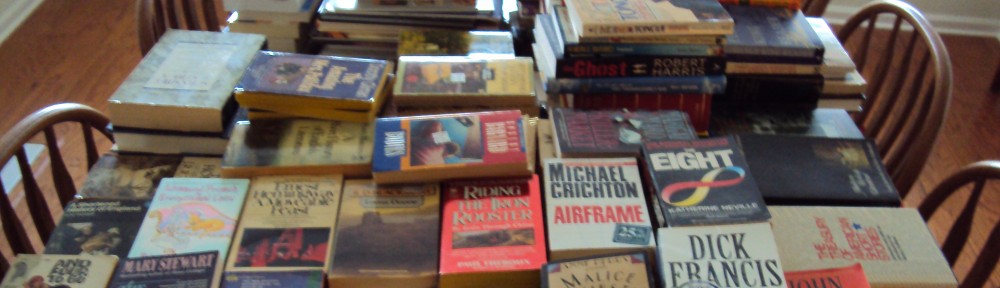
I’ve been so busy reading that I haven’t made time to write in quite a while. I have been keeping a list of what I’m reading, and the books kind of sort themselves into categories. First one is the Tried and True, all books that I own by some of my favorite authors.
In my last post, I had just started reading Fatherland, by Robert Harris. I read this book years ago, and the only thing I really remembered about it was the setting in a post World War II world where the Nazis didn’t lose. I had a vague idea that the story was a murder investigation by a homicide detective in occupied Britain, but the murders and investigation happen in Germany. I thought Harris did a great job of establishing the historical base of real people and events in Nazi Germany, then extrapolating forward to 1964, just before Hitler’s birthday celebration and a state visit by the U.S. president. Harris’ hypothetical Berlin is a plausible setting for a standard issue maverick homicide detective with ex-wife issues who gets a lot more interesting as he stubbornly persists when a murder investigation takes him deep into the worst of past and present Nazi evildoing. Robert Harris is a true favorite of mine; I wish he had written more books.
I have never been that interested in John Le Carre’s post Cold War books; I have several that I had bought but never read. Our Game, written in 1995, is one of the first, about a British intelligence cold warrior put out to pasture when his experience is no longer considered useful. I found the storyline about the former agent and his gorgeous much younger girlfriend tedious, but then the girlfriend runs away with another former agent whose unquenchable idealism and adrenaline addiction take the story into the Chechnyan separatists’ fight against the Russians, and the history of their struggle is tragic and still timely. I finished this book not long before the Boston Marathon bombings, and the way the information about the bombers and their family’s background in Chechnya and Dagestan meshed with the grim details in Our Game was eery.
I read Mrs. Pollifax and the Lion Killer, and trusty Dorothy Gilman did a believable job with the cultural and political atmosphere of this good story set in the imaginary African country of Ubangiba. Unfortunately, this is the last Mrs. Pollifax book and there will be no more. Good thing I enjoy rereading books from this series.
My Deborah Knott series reread book was Killer Market, set in the furniture showrooms in High Point, North Carolina. I haven’t been to High Point, but we’ve visited the huge furniture mall in Hickory NC; bought furniture there too. Margaret Maron is good at researching the details for her books, and even better at folding them smoothly into the plot. Love this series, am waiting impatiently for the next book.
I always need a collection of short stories on hand as a break or a stopgap. The most recent ones I’ve read are by longtime favorites Agatha Christie and P.G. Wodehouse. Christie’s Thirteen Problems (Miss Marple) and Labors of Hercules (Hercule Poirot). were packed away in boxes for several years, so it was good to see them again. I have several Christie short story books, but need to do research to see if there are any more of hers out there. My current ‘need to read’ book is Meet Mr. Mulliner, by P.G. Wodehouse. No Jeeves and Bertie Wooster in these short stories, but Mr. Mulliner and his many relations are classic in their own right.
I have to admit that even I can reread books too many times: I just about have the short story collections on my shelves committed to memory. So I’ve started reading my Calvin and Hobbes books again, still incredibly good.