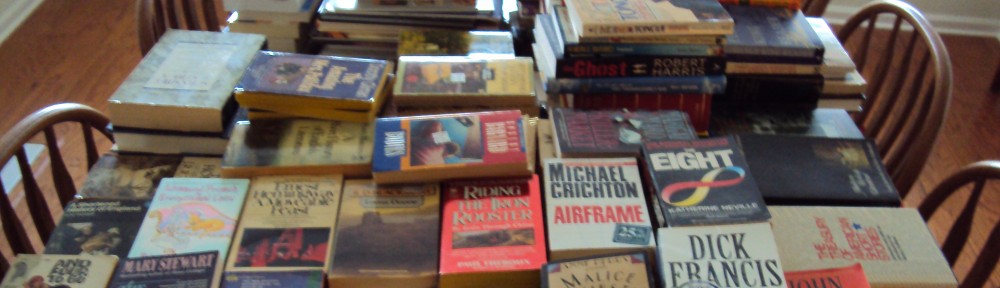
Finally went to the library, first time in months. Our nearest branch of the library isn’t very big, but I found a couple of books that are on my list, as well as books by authors I have read before and liked. I already finished The Tourist by Olen Steinhauer, a standard type spy thriller. I hadn’t read anything by Steinhauer before, so at least it’s good to find something from a new author. The book was OK, but I saw the plot twist and guessed the ending way too early. The characters and locations weren’t that interesting either. If I come across another book by this author, I’ll give it a try, but I’m not going to be looking that hard.
I finished The Kashmir Shawl, by Rosie Thomas, (Kindle book) last week and enjoyed it enough that I looked for another Thomas book at the library and found one called The Potter’s House. I liked the settings of The Kashmir Shawl: the city of Srinigar in Kashmir, an Indian state called Ladakh in the north of the country, and Wales. The best parts of the book were about the friendship of three English women in Srinigar during World War 2; the parts about a granddaughter of one of the women trying to find out the history of her grandmother’s Kashmir shawl were less interesting to me. Some genteel romantic entanglements, and information about making pashminas, early mountaineering techniques and Welsh missionaries in India moved the plot along and made for leisurely pleasant reading. My favorite details were ones about the winter weather, I’d never thought about India having snow, but of course it makes sense with the Himalayas on the northern border. Most niggling thing was trying to figure out how the Welsh names of two of the characters should be pronounced.
The Scramble for Africa, by Thomas Pakenham, is fascinating but slow going, I read a couple of chapters at a time, which works because each chapter deals with one separate region in one fairly short time period. I’m almost halfway through the book; the exciting explorer stories are finished and now it’s mostly about European politics and rivalries driving a very messy scramble for African colonies. Now I realize I need to know at least a little bit about the Franco-Prussian War of 1870-71 in order to get a better perspective on why the Great Powers were so goofy in the late 19th century. Wikipedia will have to do for now, the library didn’t have anything on 19th century European history.
Fun facts about Thomas Pakenham: he is the 8th Earl of Longford, although he doesn’t use the title, and one of his sisters is romance novelist Antonia Fraser.
In between French and English shenanigans in Africa I re-read a favorite mystery that had been packed away in a box for several years: Thus was Adonis Murdered, by Sarah Caudwell. Sarah Caudwell wrote three books about Hilary Tamar, a professor of legal history, and his/her friends, young members of the Chancery Bar in London (lawyers). I really can’t figure out if Hilary is a man or a woman; I don’t know if it’s just me, or if Sarah Caudwell is being deliberately confusing. It’s kind of like the young Mrs deWinter’s name in Rebecca – I’m pretty sure Daphne du Maurier left it out on purpose. I’m not clear on how the British legal system works either; however, in spite of all the confusion the books are very funny and clever and I always enjoy reading them. A lot of this one is in the form of long letters from one of the lawyers on vacation holiday in Venice. Book published in 1981, not that long ago but well before the age of Internet and the cell phone.
I’ve started on another library book called Girl Sleuth: Nancy Drew and the women who created her, by Melanie Rehak. This one wasn’t on my list, but looked intriguing. The story so far: Carolyn Keene didn’t write the Nancy Drew books! In fact she never existed! Other people wrote the books! I think I already knew this, but I didn’t know all the details about the children’s book syndicate that developed Nancy Drew (and the Hardy Boys and the Bobbsey Twins, among many other series), but Melanie Rehak certainly knows everything and wants to write about all of it. I’m thinking this might be one of those books with 100 pages of material expanded to 300, but I’ve read and enjoyed lots of Nancy Drew books and I think I can get some good stuff out of this and skim the rest.
Which leads to a digression: before I read the all-American girl Nancy Drew detective stories, I read the Famous Five and Secret Seven children’s mysteries by Enid Blyton. I don’t think many, if any, of Enid Blyton’s books made it to the US; I read them when we lived in southern Africa when I was in elementary primary school. “Enid Blyton” wrote hundreds of books (most of which I haven’t read) so many in fact that I wondered if her name was the nom de plume of a writing syndicate too. So to Wikipedia, which says that Enid Blyton was a real person and it’s sufficiently clear that she wrote all her books herself. It also, in an interesting and fair-minded way, says that she was a Grade A Number 1 Mommie Dearest bitch whose books are racist, sexist and classist, and many discerning people say that the books have no literary merit either. I have little patience with people who look down on books because they are commercially successful, but there are examples to show that Enid Blyton inserted some language, ideas and characters into her books that were nasty then and are clearly unacceptable now. I see on amazon.co.uk that the Famous Five and Secret Seven books are still in print. I loved the books and consumed them like potato chips, I hope I just skipped over bad words and stereotypes and didn’t let them into my heart. The Wikipedia article said the publishers have made judicious edits to the books and kids still enjoy them.
Can’t help it, just one more digression: The Mommie Dearest image of Enid Blyton comes from a book that one of her daughters wrote. Now I remember that Christopher Robin Milne hated the Winnie-the-Pooh books and didn’t have many good things to say about his father A.A. Milne. I hope none of J.K. Rowling’s kids write, or have reason to write, a mean book about her. She seems like a very nice person, as well as a good writer.