I thought that I would read more books and post more blog entries as I stayed housebound during Charleston’s hot and sticky summer, but it didn’t turn out that way. A lot of this dereliction was caused by a Kindle game called Every Word, an addictive scrambled word game that the friendly Amazon people give Kindle owners for free. A big time-suck, but so much fun. I did get some reading in, though.
New (to me) books
I finished the second half of Midnight Rising (my book), an exciting and sad account of John Brown’s inexplicably nutty attack on Harpers Ferry. Tony Horwitz finds heroism and cruelty on all sides of the attack and during the subsequent trial and execution of Brown and his captured men. The story of John Brown and Harpers Ferry is familiar to me, but Horwitz makes a particulary detailed and compelling case that Brown’s actions and their consequences were pivotal in the run-up to the Civil War. There is a long period between publication of each of Horwitz’s books, but they are always worth the wait.
I read half of The Potter’s House, by Rosie Thomas (library book), then flipped through to see how it turned out. Slow, boring, silly. I liked Thomas’ Kashmir Shawl, so this was a disappointment. I’m glad I didn’t spend any of my money on this thing.
Same thing with False Mermaid, by Erin Hart (library book). This is Hart’s third book about a pathologist named Nora Gavin. I’m a bit tired of pathologists in mystery series, but I really liked the first book in this series, Haunted Ground (Kindle book), especially the setting in Ireland and the details about ancient Irish history. I thought the story about the years-back murder of Nora’s sister, heavily referenced in the first book, would be compelling, but it felt kind of flat. Glad the library had it and I didn’t have to buy it. I still want to read the second book, Lake of Sorrows, because Hart can be that good.
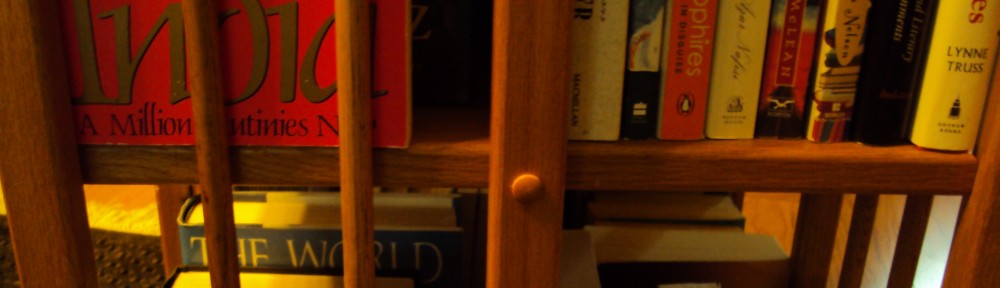
I also read two books (library books) that aren’t just new, but by a new author: Alan Furst. I read about Furst in an article about a new British mini-series starring the former, fabulous Doctor Who, David Tennant. The series is called The Spies of Warsaw, from the book of the same name by Alan Furst, “master of the historical spy novel”, according to Amazon. So I added Alan Furst to my library list, and the library had two of his books. The World at Night is set in Paris just before and during the first part of the German occupation, and Dark Voyage is set on a Dutch tramp steamer in May and June 1941. In a nutshell, The World at Night is about a French guy who has sex with different women and one fairly simple spy mission. Boring both as a spy story and a love story. Dark Voyage was a lot better with more interesting characters, and I liked the stories about the ship’s clandestine work for the British in the Mediterranean and the Baltic. Still, Furst is a library and maybe used book store author for now. On the other hand, I can hardly wait until January to see David Tennant in the new series.
Old Favorites
I picked Archangel, by Robert Harris, off one of my shelves, read every word and thoroughly enjoyed it. I read it years ago, but remembered hardly anything about it so it was almost like a new book. Great characters and a really good story, based on events that started with the death of Stalin, and continue in post-USSR Russia. Reading one of Harris’ novels is always a treat, but unfortunately he hasn’t written very many of them.
I thought I would be reading a new book when I picked John LeCarre’s The Secret Pilgrim from another shelf, but realized fairly soon that I’d read it before. I’ve bought several of LeCarre’s post-Cold War novels, but never really got into them. I thought The Secret Pilgrim was one of those, but it consists mainly of an old spy named Ned reminiscing about (cold) war stories while George Smiley talks to a class of new spies. The book was written in 1990, just after the break up of the Soviet Union and the end of the Cold War, and John LeCarre, through George Smiley and Ned, has some prescient things to say about how the world would change after the victory of the West and capitalism.
I then read a book, Pray for a Brave Heart (my book), by another great espionage author, who has a different perspective on the Cold War than LeCarre. British author Helen MacInnes wrote Above Suspicion, one of my favorite spy novels, just before World War 2, followed by a couple more books set in occupied Europe. MacInnes and her husband moved to the US after the war, and, after two lackluster novels, she found her niche in writing bestselling books about innocent Americans caught up in the Cold War struggle against Communism. MacInnes tends to be earnest in these books, and seems to have lost her British sense of irony after she came to the US, but she is a fantastic storyteller and idealistic without being dogmatic. Starting with Pray for a Brave Heart in 1955, she wrote six superb espionage novels set in various interesting European locations, good reads every one. After 1968, I find the quality of her books a little more hit and miss, but even at less than her best, her books are very good. Most of Pray for a Brave Heart is set in Zurich and a small mountain town not far away, and I enjoyed the descriptions of these places and how they were used in the plot. The central plot concerns smuggling notable East Europeans out from behind the Iron Curtain, very current affairs for 1955, and still exciting to read about. I was pleased to see that this book, as well as Above Suspicion, will be available in new editions in early 2013. Nice to see this author getting attention again.
Instead of reading the good non-fiction book I bought about the Indian Mutiny, I reread Flashman and the Great Game (my book), in which Flashman is caught in besieged Cawnpore and Lucknow and sees and experiences conditions similar to those in The Siege of Krishnapur. As usual, he has many other adventures involving real historical people, he fornicates freely, extricates himself from deadly situations by the skin of his teeth, and n-words every non-European he comes across. Love Flashman, get tired of some of the things he says. While I was reading Great Game, I was also reading Midnight Rising. After I finished them, I thought I’d read Flashman and the Angel of the Lord, which is also about John Brown and Harpers Ferry, again. But too much Flashman in a row is not a good thing, I put the book back and will take a Flashman break for a while.
I enjoyed rereading Sarah Caudwell’s Thus was Adonis Murdered so much, that I started her The Sirens Sang of Murder, and again it was a problem of reading two books by a talented but very stylized author in a row. The witty young lawyers and their clever bantering lose too much of their charm when taken in too much quantity, so Caudwell needs to also be put aside for a while.