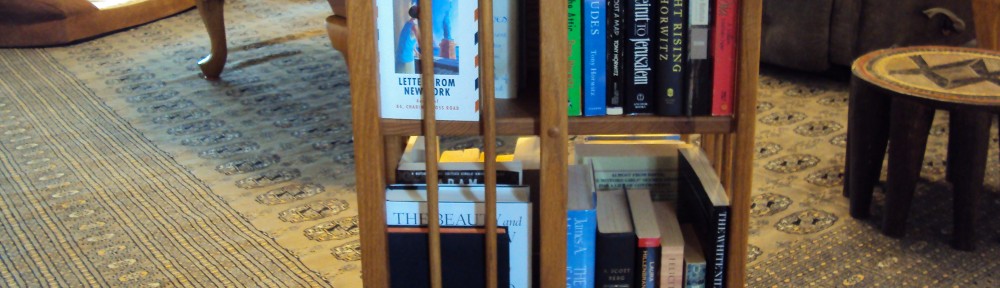
I have been participating in the Center for Creative Retirement’s (CCR) book group, and it has introduced me to some very interesting reading. After Caleb’s Crossing, the next book was called Deerhunting with Jesus: Dispatches from America’s Class War, by Joe Bageant. After many years, Joe Bageant returned to his hometown of Winchester, Virginia, and found that old friends and neighbors were falling farther and farther behind in the American quest for the good life. Joe got pretty upset about the economic and political forces that were making mincemeat out of the decent, hardworking, goodhearted people of Winchester, so he wrote this interesting but uneven polemical book. For me, the most fascinating part was the chapter on the mortgage racket that has trapped so many people in terrible debt – fascinating because the book was published in 2007, before the sub-prime mortgage induced crash hit. So many people knew about systemic mortgage abuses, and tried so hard to get the word out, well before the whole stinking pile came crashing down in 2008 and could no longer be ignored. OK, I am clearly with Joe in being angry with the sleazebags ripping off working America. But the chapter on guns was convolutedly weird.
Since I was reading about the class war, I decided to go ahead and get a couple of books that had been on my list for a while: The Great Divergence, by Timothy Noah, and Coming Apart, by Charles Murray. I had read and appreciated Timothy Noah’s series of articles, also called The Great Divergence, on Slate.com, and thought it was worth having the expanded version in book form. Noah’s writing about growing inequality is more analytical and less anecdotal than Bageant’s, but the book’s impact is even more powerful. I read a little at a time, because it is really depressing.
Coming Apart is subtitled ’The State of White America, 1960-2010′. Charles Murray is the controversial but very erudite libertarian author of The Bell Curve, for which he was much critcized by people whose opinions Charles Murray doesn’t care about. Basically, in this new book I think Murray is saying that the white working class is in trouble because they’re shiftless, with weakened morals and no ambition, but Charles Murray doesn’t care what I think either. While I don’t agree with Murray, his work is not mean-spirited and his careful research raises interesting and important points about income inequality, whether Murray believes in such a thing or not.
I joined the book club too late to discuss Major Pettigrew’s Last Stand, by Helen Simonson, but it has been on my reading list for a long time, and I decided if it was interesting enough for the book group, I’d might as well read it. I enjoyed the story of the culture clash that surrounds the endearing friendship between the retired British major and the widowed Pakistani shopkeeper. The very British family feud about a pair of heirloom shotguns and the generational problems in the Pakistani family struggling with assimilation were realistic and the resolution of the two plots was satisfying.
Although I read Madonnas of Leningrad, I didn’t make it to the book group’s discussion, which I heard was very good. The heroine’s memories of her experiences sheltering in the Hermitage Museum during the Nazi siege of Leningrad are vivid and detailed, much more real to her than her present day life as an old woman suffering from dementia in the U.S. The madonnas of the title are the subjects of some of the Hermitage’s most beautiful and precious paintings, present only in the memories of the museum employees during the siege since the paintings had been sent away for safekeeping as the Germans advanced on Leningrad. The tenuous relationship between memory and reality is deftly presented through the story, with an ending that I found intriguingly ambiguous.
The most recent book group selection was Mornings on Horseback, by David McCullough. Although McCullough is an exceptional author and I have enjoyed his books, I had no particular interest in the subject of this book: Teddy Roosevelt’s life until he was 27. Without the book group, I would not have read it, and I would have missed out on something fascinating. I thought I knew everything I would ever need to know about TR’s sickly childhood, wealthy family, and cowboy doings in the West, but I was wrong. The quirks, accomplishments, travel and tragedies of the Roosevelt family were unexpectedly enthralling, but I did find the dude experiences of Teddy and his dude friends in the Badlands oddly superficial. For me, the best and most memorable part of the book was TR’s early political career, in what I had hitherto thought of as the very boring “Presidents with Beards” period of the late 19th century. Wow, those politicians dealt with some momentous political issues, and their wheeling and dealing was blatant and effective. The big eye-opener was that TR’s ultimately successful foray into politics was completely unprecedented for a wealthy young New York City gentleman. He barged in where he was unexpected and not especially welcome, and made a place for himself. Also, I loved all the details about his sumptuous wardrobe, the man was a snappy dresser. The buckskin suit is to die for.
The next book is The Round House, by Louise Erdrich. I think I’ll read it on my Kindle, and experiment with the highlighting feature.