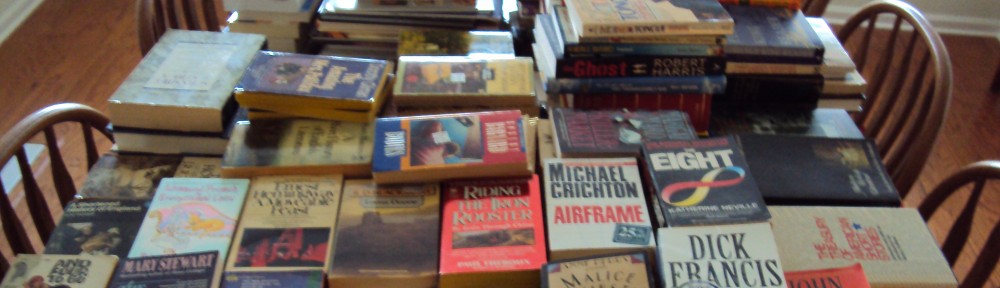
I bought some books

I love finding discounted, really cheap, or no-cost books, but sometimes I do splurge on regular-priced books.  These are nearly always books from Amazon, so even their ‘regular’ prices are pretty reasonable.  I have bought most of the CCR book group books we’ve read as regular-priced Kindle books.  The group tends to choose recent books that are not yet available in paperback, and the Kindle editions are cheaper and less bulky than hardbacks.  I did luck out on Madonnas of Leningrad, which was $2.99 on Kindle, and I bought Mornings on Horseback in a very nice trade paperback edition; it was published some years ago, and I prefer to read nonfiction in print editions, especially if the book has photographs (or maps).  I also bought some of the Maisie Dobbs books at regular price, and several other new-to-me-author books at regular price, but I’ve already written about them.  Here are three I bought and read recently:

Band of Brothers, by Stephen Ambrose:  The book is about the men of Easy Company, 101st Airborne Division, who parachuted into Normandy on D-Day and fought their way through France, the Low Countries and Germany all the way to Hitler’s Eagle’s Nest.  I’d been wanting to read this since I saw the mini-series, even more so after I read The Wild Blue and realized what a good writer Stephen Ambrose was.  It’s a nice trade paperback, and it was definitely the right decision to get it in a print edition.  There are so many people in the book, and they keep moving between companies and platoons and battalions so much I had to keep flipping back to keep track of who was who.  Not to mention I had to keep going back to read the definitions of companies, platoons and battalions.

I loved and appreciated the honesty of the Easy Company men Ambrose interviewed for the book, and he did a phenomenal job of working their stories into a fast-paced, coherent narrative.  The consequences of the higher-ups’ good planning or arrogant folly or dumb luck are starkly clear in Ambrose’s swift scene-setting details of the D-Day landing, the shambles of Market Garden, and the intelligence failures leading to the Ardennes trap in the Battle of the Bulge.  Ambrose also explained how thoroughly the paratroopers were trained; in the movies, it always looks like the group of geographically and ethnically diverse soldiers are plucked from the cities, towns and farms of America, and are in combat the week after basic training.  I was impressed at the planning, selectivity and time the U.S. Army put into the paratroopers’ training, similar to the care that went into training the bomber pilots in The Wild Blue.   It’s unusual for me to think of ‘training’ as heroic and life-saving, but Ambrose makes it crystal clear that even the bravest men benefited greatly from their thorough preparation for the terrible things they had to face in combat.

I remembered some of the men and incidents in the book from the HBO mini-series, and it was good to be able to slowly read and understand many of the dramatic but confusing things in the series. The Afterword in the book was a heartfelt, inspiring and sometimes tragic synopsis of what happened to the men who survived their service in Easy Company.

The End of Your Life Book Club, by Will Schwalbe:  I was attracted to the title of this book, but quailed a little when I read that it’s a memoir Will Schwalbe wrote about books he and his mother Mary Anne read and discussed during the long months of her treatments for pancreatic cancer.  The title makes it clear that the treatments did not save Mary Anne, but the idea of facing death by reading was intriguing; I thought it would either be inspirational or unbearably grim, and it was worth the risk to read and find out.

The overall effect was: inspiring.  Will and Mary Anne and the Schwalbe siblings, spouses and grandchildren are excellent company, without being gooey or pompous, things I find irritating in most memoirs.  I usually feel cynicism coming on when I get an inkling that a book is about ‘celebrating life’ and ‘giving back’ and so on, but the Schwalbes come across as genuinely accomplished, interesting, worthwhile people.  The descriptions of Mary Anne’s extensive high-level work with refugee and development NGOs are matter of fact and highlight the importance of the work and her joy that she can be part of it.  I often think that the lack of self-awareness is a debilitating and annoying personality trait, and Mary Anne is gloriously self-aware about the blessings and good fortune of her cultured, prosperous life, and it serves to make her kind and generous.  Of course, the book’s author has a lot to do with the positive way that Mary Anne and her family are portrayed, but Will seems like an honest broker as well as a loving son, self-aware in his own right.

But all the above is basically background:  the books are the heart of the story and satisfyingly central to it.  Will and Mary Anne think and talk about books the way I do, and I enjoyed the sense of eavesdropping on their conversations.  There is also a list of all the books discussed or mentioned in the book at the end; useful, since I’m interested in reading some of them (yet more books for the list).  Finally, I was surprised that the description of the cancer treatment was so honest and interesting. The doctor tells Mary Anne her cancer can be “treated, not cured”, and the details of the medicines, side effects and complications are so deftly handled, the impression is of a quest, not simply an ordeal.  I found this book moving and very satisfying, I learned a lot and felt a lot.

The Big Book of Christmas Mysteries, edited by Otto Penzler:  The Kindle edition was $10.99, an excellent price for 59 stories with a print length of 674 pages.  I’m still working my through this one.  It’s always comforting to have a good mystery anthology at hand, and this is a very good one.  I wasn’t aware of Otto Penzler before, but it seems he is a well-know editor of mystery anthologies, so I’ll want to get to know him better.  I like the way this book is organized; there is an easy to use table of contents divided into different categories of stories (traditional, funny, hard-boiled and so on) and I can link to any story I want and jump around in the book the way I like to.  But I still can’t tell how long a story is:  I’ll want a quick story to finish before I go to sleep, but the one I’m reading goes on and on and on, with no way of knowing how much more of it there is.  At least I don’t have to find someplace to put a 674 page book.

Eight weeks and counting …

Eight weeks and counting since I posted anything on the blog.  Spending too much time playing Every Word and watching new episodes of TV shows.  Also, my reading speed for non-fiction books and literary novels is still  v e r y  v e r y  s l o w, and I have trouble sitting still and concentrating for the three or four hour sessions I need to really get involved in these books.  Maybe my concentration will improve as I get more stuff sorted and put away, given away or thrown away. I did manage to finish eight books – an average of one per week – since my last post, so I do have something to write about.

Library trip #1

I checked out The Jury Master, a ”lawyer mystery” by Robert Dugoni; Death Comes to Pemberley, a fake sequel to Pride and Prejudice by P.D. James; The Wild Blue, a non-fiction book by Stephen Ambrose about bomber crews based in World War II Italy; and 1861: The Civil War Awakening, a non-fiction book by Adam Goodheart.

I enjoyed The Jury Master; lawyer David Sloane is an interesting protagonist and the plot had a great twist.  The writing is a little clunky, but the good story makes up for it.  The best thing about this book, though, was my epiphany about reading light fiction:  you don’t have to read every word to get through the story without cheating and flipping to the end.  It’s better to skim through the middle of the book, and get more fun out of the character and plot high points while making a fairly orderly progression to the end of the book.  This method has greatly enhanced my enjoyment of the library novels I have read since the epiphany.  The method was especially useful in getting through Death Comes to Pemberley.  I was looking forward to this book by the great mystery novelist P.D. James, with Elizabeth Bennet Darcy as detective, but it was a letdown.  P.D. James came up with a pretty good plot and some cute details about the post-Pride and Prejudice lives of the Bennet sisters, but I thought it was a skim-through-the-middle book.  Better writing and a better effort than A Presumption of Death, the fake Lord Peter Wimsey sequel, but still disappointing.  Once again, I’m grateful that the library had a copy and I had a chance to read it without buying it. 

There’s a back story to my choice of The Wild Blue, a book I hadn’t heard of before finding it in the library.  The story starts with “The National World War II Museum” in New Orleans: Alan and I were fascinated and moved by its detailed exhibits about the D-Day landings in Normandy and the amphibious landings in the Pacific war theater.  I had never read anything by Stephen Ambrose, the popular historian who was one of the people instrumental in establishing the museum, but we did have the blu-ray edition of the TV series Band of Brothers, based on Ambrose’s book of the same name.  The series is excellent, but some of the details about the men of Easy Company got lost in the action on the screen, and I wanted to know more about them, so reading Band of Brothers was the next logical step.  I am trying to make the library my first stop in looking for books – my bookshelves are already overcrowded, and I still prefer reading real books over e-books.  No Band of Brothers at the library, but they did have The Wild Blue.  The book is about the training and bombing missions of B-24 Liberator crews flying out of Italy in World War II, and the main focus of the book is George McGovern and his bomber crew.  George McGovern had recently passed away and there had been many obituaries and articles about his life and career, so this was a timely choice and a good way to check out whether I like Stephen Ambrose’s writing style.  Yes!  Good choice by a talented writer with a gripping writing style.  Ambrose interviewed McGovern, members of his crew, and other fliers, then put their stories together into a compelling narrative.  It’s a history of Army Air Force training methods, aircraft production, and bombing missions over Germany, told through the skillfully interwoven recollections of the men and families who lived through the story.  Very readable, very informative.  I’m looking for space on the bookshelves for Band of Brothers, which is, I understand, written the same way.

Bringing me to 1861.  I was pleased and a little surprised to find this well-reviewed, well known book just waiting for me on the library shelf.  I was really looking forward to reading it, but decided to read The Wild Blue first.  As noted above, my reading speed for non-fiction is slow, even for interesting, well-written ones.  So I found myself with two days left until 1861 was due, started reading it, decided it was terrific, and crossed my fingers that I would be able to renew it.  Success, I renewed it for three more weeks, as well as another book called The Reading Promise: My Father and the Books We Shared.  To keep my focus on these two books, I didn’t check out any more; no distractions.  (to be continued)

1861, The continuing saga of.  Or, Library trip #2

After library trip #2, I set myself to reading 1861 with a will.  It’s about the months leading up to the beginning of the Civil War, largely from the point of view of those dedicated to preserving the Union.   Goodheart structures his history around the stories of individuals in places like Ohio, St. Louis and San Francisco, although the book starts, as many Civil War histories do, at Fort Sumter.  However, this Fort Sumter narrative has many more details about the thoughts and motivations of Major Anderson and the other, lesser known, officers and men holding the fort, and much more about the impact of their heroic efforts on public opinion in the north and the mid-west.  Goodheart continues with variations on this narrative model:  individuals act with conviction, their actions are catalysts for changes in public opinion, which then feeds an ever-widening determination to save the Union.  Some names of the individuals Goodheart highlights are mentioned in passing in more conventional histories of the Civil War, but in this book people and events and places, usually lying well outside the main Civil War narrative, reveal a new and exciting perspective on the communities that answered Lincoln’s call to preserve the Union.  I get excited just writing about this book, and savored every word I read; so much so, that I didn’t finish the book before its second due date.  This time, I was out of luck; somebody had a hold on the book so I couldn’t renew it.  Only one chapter to go once I get the book back in my grasp (to be continued).

Library trip #2.5

 Since I couldn’t renew 1861 on this trip, I decided to check out more books of a less demanding nature, just to get back in the habit of reading new things and practice my skimming technique.  I also decided to hang on to The Reading Promise, since it was available for renewal. 

I’ve already finished Bodily Harm, another David Sloane mystery by Robert Dugoni.  Not as good as The Jury Master, but still entertaining.  Next I finished Christopher’s Ghosts, by Charles McCarry.  I understand that McCarry wrote a series of spy thrillers about Paul Christopher, then retired from writing.  In 2004, he came out of retirement to write a book called Old Boys; Paul Christopher is a character in this book, but isn’t one of the main protagonists.  I read Old Boys (bought at a used bookstore) a couple of years ago, and thought it  was great, with a genuinely thrilling story and wonderful exotic locations.  Christopher’s Ghosts was written after Old Boys, and is about 16 year old Christopher, his parents, and his first love in 1939 Berlin, with the events of that time coming to resolution in 1959.  Sort of a prequel to the main Paul Christopher series, none of which I have read.  It’s a pretty good, well written book, but it doesn’t have the punch of Old Boys.      

I just started a book called The House at Sea’s End, by Elly Griffiths, from yet another forensic archaeologist series; this character is named Ruth Galloway.  It’s pretty good so far, I like the slightly off beat writing, and the mystery about six bodies revealed in a cliff fall seems interesting.  I have the first book of the series, The Crossing Places, on my Kindle, but haven’t read it yet.

The fourth novel I checked out is a spy thriller, The Nearest Exit, by Olen Steinhauer.  I read Steinhauer’s The Tourist, an earlier book also featuring the spy Milo Weaver, a few months ago.  I wasn’t overwhelmed, but it was entertaining enough and I think this one will be too.

The Reading Promise is short and looks like a sweet book, but I can’t quite get started on it.

Keeping count of the eight books I read in eight weeks:  in this post so far I’ve written about five library books I finished and 1861, the library book I almost finished.  Two more to go.

Old book, new book.

My only mystery short story book for this time period was Crime through Time (the first one – my book).  Good stories, better collection overall than Crime through Time III (also my book).  There must be a Crime through Time II, I’ll have to see if I can track down a copy.

The new book is, hooray hooray, The Buzzard Table, the latest Deborah Knott mystery by Margaret Maron.  I bought it for my Kindle the day it was released.  The Kindle is fine for books like this; I knew I was going to zip right through and read every word.  I liked this book more than the last one, Three Day Town; Deborah is back in Colleton County NC with her exuberant extended family and the mystery plot is better.  New York detective Sigrid Harald, from Maron’s other series, is also in this book, on a family visit with her mother.  Margaret Maron’s switches between her characters’ points of view get a little frantic in this book, and Deborah’s first person narrative, the best feature of the series, gets too lost at times.  But any Deborah Knott is better than no Deborah Knott, and right now books in this series have the distinction of being the only ones I buy as soon as they come out.  

Pending books

I’m working through Eats, Shoots and Leaves (my book) one delightful chapter after another.  I just finished the one on the apostrophe, its distinguished history and its use, misuse and abuse in contemporary times.

The Scramble for Africa (my book) went into hiatus and probably won’t come back out for a while.  I read 380 of 680 pages and after the exciting exploration and derring-do parts I got stuck in the important but depressing and intricate details of the full-fledged European colonization of Africa.  Pakenham carefully describes the bumbling and manipulation of clueless governments floundering into poorly planned adventures while doing great damage to the Africans, and it got me down.

It’s better to have a book of my own on hiatus, and know I can start it back up any time I want.  I’m still a little bit in shock from the 1861 forced hiatus, which I admit is mostly my own fault.  Maybe I should put myself out of my misery and just buy the book.