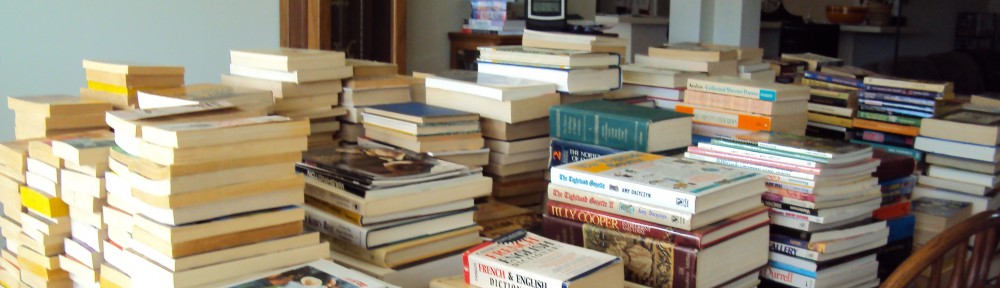
Eight weeks and counting …

Eight weeks and counting since I posted anything on the blog.  Spending too much time playing Every Word and watching new episodes of TV shows.  Also, my reading speed for non-fiction books and literary novels is still  v e r y  v e r y  s l o w, and I have trouble sitting still and concentrating for the three or four hour sessions I need to really get involved in these books.  Maybe my concentration will improve as I get more stuff sorted and put away, given away or thrown away. I did manage to finish eight books – an average of one per week – since my last post, so I do have something to write about.

Library trip #1

I checked out The Jury Master, a ”lawyer mystery” by Robert Dugoni; Death Comes to Pemberley, a fake sequel to Pride and Prejudice by P.D. James; The Wild Blue, a non-fiction book by Stephen Ambrose about bomber crews based in World War II Italy; and 1861: The Civil War Awakening, a non-fiction book by Adam Goodheart.

I enjoyed The Jury Master; lawyer David Sloane is an interesting protagonist and the plot had a great twist.  The writing is a little clunky, but the good story makes up for it.  The best thing about this book, though, was my epiphany about reading light fiction:  you don’t have to read every word to get through the story without cheating and flipping to the end.  It’s better to skim through the middle of the book, and get more fun out of the character and plot high points while making a fairly orderly progression to the end of the book.  This method has greatly enhanced my enjoyment of the library novels I have read since the epiphany.  The method was especially useful in getting through Death Comes to Pemberley.  I was looking forward to this book by the great mystery novelist P.D. James, with Elizabeth Bennet Darcy as detective, but it was a letdown.  P.D. James came up with a pretty good plot and some cute details about the post-Pride and Prejudice lives of the Bennet sisters, but I thought it was a skim-through-the-middle book.  Better writing and a better effort than A Presumption of Death, the fake Lord Peter Wimsey sequel, but still disappointing.  Once again, I’m grateful that the library had a copy and I had a chance to read it without buying it. 

There’s a back story to my choice of The Wild Blue, a book I hadn’t heard of before finding it in the library.  The story starts with “The National World War II Museum” in New Orleans: Alan and I were fascinated and moved by its detailed exhibits about the D-Day landings in Normandy and the amphibious landings in the Pacific war theater.  I had never read anything by Stephen Ambrose, the popular historian who was one of the people instrumental in establishing the museum, but we did have the blu-ray edition of the TV series Band of Brothers, based on Ambrose’s book of the same name.  The series is excellent, but some of the details about the men of Easy Company got lost in the action on the screen, and I wanted to know more about them, so reading Band of Brothers was the next logical step.  I am trying to make the library my first stop in looking for books – my bookshelves are already overcrowded, and I still prefer reading real books over e-books.  No Band of Brothers at the library, but they did have The Wild Blue.  The book is about the training and bombing missions of B-24 Liberator crews flying out of Italy in World War II, and the main focus of the book is George McGovern and his bomber crew.  George McGovern had recently passed away and there had been many obituaries and articles about his life and career, so this was a timely choice and a good way to check out whether I like Stephen Ambrose’s writing style.  Yes!  Good choice by a talented writer with a gripping writing style.  Ambrose interviewed McGovern, members of his crew, and other fliers, then put their stories together into a compelling narrative.  It’s a history of Army Air Force training methods, aircraft production, and bombing missions over Germany, told through the skillfully interwoven recollections of the men and families who lived through the story.  Very readable, very informative.  I’m looking for space on the bookshelves for Band of Brothers, which is, I understand, written the same way.

Bringing me to 1861.  I was pleased and a little surprised to find this well-reviewed, well known book just waiting for me on the library shelf.  I was really looking forward to reading it, but decided to read The Wild Blue first.  As noted above, my reading speed for non-fiction is slow, even for interesting, well-written ones.  So I found myself with two days left until 1861 was due, started reading it, decided it was terrific, and crossed my fingers that I would be able to renew it.  Success, I renewed it for three more weeks, as well as another book called The Reading Promise: My Father and the Books We Shared.  To keep my focus on these two books, I didn’t check out any more; no distractions.  (to be continued)

1861, The continuing saga of.  Or, Library trip #2

After library trip #2, I set myself to reading 1861 with a will.  It’s about the months leading up to the beginning of the Civil War, largely from the point of view of those dedicated to preserving the Union.   Goodheart structures his history around the stories of individuals in places like Ohio, St. Louis and San Francisco, although the book starts, as many Civil War histories do, at Fort Sumter.  However, this Fort Sumter narrative has many more details about the thoughts and motivations of Major Anderson and the other, lesser known, officers and men holding the fort, and much more about the impact of their heroic efforts on public opinion in the north and the mid-west.  Goodheart continues with variations on this narrative model:  individuals act with conviction, their actions are catalysts for changes in public opinion, which then feeds an ever-widening determination to save the Union.  Some names of the individuals Goodheart highlights are mentioned in passing in more conventional histories of the Civil War, but in this book people and events and places, usually lying well outside the main Civil War narrative, reveal a new and exciting perspective on the communities that answered Lincoln’s call to preserve the Union.  I get excited just writing about this book, and savored every word I read; so much so, that I didn’t finish the book before its second due date.  This time, I was out of luck; somebody had a hold on the book so I couldn’t renew it.  Only one chapter to go once I get the book back in my grasp (to be continued).

Library trip #2.5

 Since I couldn’t renew 1861 on this trip, I decided to check out more books of a less demanding nature, just to get back in the habit of reading new things and practice my skimming technique.  I also decided to hang on to The Reading Promise, since it was available for renewal. 

I’ve already finished Bodily Harm, another David Sloane mystery by Robert Dugoni.  Not as good as The Jury Master, but still entertaining.  Next I finished Christopher’s Ghosts, by Charles McCarry.  I understand that McCarry wrote a series of spy thrillers about Paul Christopher, then retired from writing.  In 2004, he came out of retirement to write a book called Old Boys; Paul Christopher is a character in this book, but isn’t one of the main protagonists.  I read Old Boys (bought at a used bookstore) a couple of years ago, and thought it  was great, with a genuinely thrilling story and wonderful exotic locations.  Christopher’s Ghosts was written after Old Boys, and is about 16 year old Christopher, his parents, and his first love in 1939 Berlin, with the events of that time coming to resolution in 1959.  Sort of a prequel to the main Paul Christopher series, none of which I have read.  It’s a pretty good, well written book, but it doesn’t have the punch of Old Boys.      

I just started a book called The House at Sea’s End, by Elly Griffiths, from yet another forensic archaeologist series; this character is named Ruth Galloway.  It’s pretty good so far, I like the slightly off beat writing, and the mystery about six bodies revealed in a cliff fall seems interesting.  I have the first book of the series, The Crossing Places, on my Kindle, but haven’t read it yet.

The fourth novel I checked out is a spy thriller, The Nearest Exit, by Olen Steinhauer.  I read Steinhauer’s The Tourist, an earlier book also featuring the spy Milo Weaver, a few months ago.  I wasn’t overwhelmed, but it was entertaining enough and I think this one will be too.

The Reading Promise is short and looks like a sweet book, but I can’t quite get started on it.

Keeping count of the eight books I read in eight weeks:  in this post so far I’ve written about five library books I finished and 1861, the library book I almost finished.  Two more to go.

Old book, new book.

My only mystery short story book for this time period was Crime through Time (the first one – my book).  Good stories, better collection overall than Crime through Time III (also my book).  There must be a Crime through Time II, I’ll have to see if I can track down a copy.

The new book is, hooray hooray, The Buzzard Table, the latest Deborah Knott mystery by Margaret Maron.  I bought it for my Kindle the day it was released.  The Kindle is fine for books like this; I knew I was going to zip right through and read every word.  I liked this book more than the last one, Three Day Town; Deborah is back in Colleton County NC with her exuberant extended family and the mystery plot is better.  New York detective Sigrid Harald, from Maron’s other series, is also in this book, on a family visit with her mother.  Margaret Maron’s switches between her characters’ points of view get a little frantic in this book, and Deborah’s first person narrative, the best feature of the series, gets too lost at times.  But any Deborah Knott is better than no Deborah Knott, and right now books in this series have the distinction of being the only ones I buy as soon as they come out.  

Pending books

I’m working through Eats, Shoots and Leaves (my book) one delightful chapter after another.  I just finished the one on the apostrophe, its distinguished history and its use, misuse and abuse in contemporary times.

The Scramble for Africa (my book) went into hiatus and probably won’t come back out for a while.  I read 380 of 680 pages and after the exciting exploration and derring-do parts I got stuck in the important but depressing and intricate details of the full-fledged European colonization of Africa.  Pakenham carefully describes the bumbling and manipulation of clueless governments floundering into poorly planned adventures while doing great damage to the Africans, and it got me down.

It’s better to have a book of my own on hiatus, and know I can start it back up any time I want.  I’m still a little bit in shock from the 1861 forced hiatus, which I admit is mostly my own fault.  Maybe I should put myself out of my misery and just buy the book.

Trip to the library

Finally went to the library, first time in months.  Our nearest branch of the library isn’t very big, but I found a couple of books that are on my list, as well as books by authors I have read before and liked.  I already finished The Tourist by Olen Steinhauer, a standard type spy thriller.  I hadn’t read anything by Steinhauer before, so at least it’s good to find something from a new author.  The book was OK, but I saw the plot twist and guessed the ending way too early.  The characters and locations weren’t that interesting either.  If I come across another book by this author, I’ll give it a try, but I’m not going to be looking that hard.

I finished The Kashmir Shawl, by Rosie Thomas, (Kindle book) last week and enjoyed it enough that I looked for another Thomas book at the library and found one called The Potter’s House.  I liked the settings of The Kashmir Shawl: the city of Srinigar in Kashmir, an Indian state called Ladakh in the north of the country, and Wales.  The best parts of the book were about the friendship of three English women in Srinigar during World War 2; the parts about a granddaughter of one of the women trying to find out the history of her grandmother’s Kashmir shawl were less interesting to me.  Some genteel romantic entanglements, and information about making pashminas, early mountaineering techniques and Welsh missionaries in India moved the plot along and made for leisurely pleasant reading.  My favorite details were ones about the winter weather, I’d never thought about India having snow, but of course it makes sense with the Himalayas on the northern border.  Most niggling thing was trying to figure out how the Welsh names of two of the characters should be pronounced.

The Scramble for Africa, by Thomas Pakenham, is fascinating but slow going, I read a couple of chapters at a time, which works because each chapter deals with one separate region in one fairly short time period.  I’m almost halfway through the book; the exciting explorer stories are finished and now it’s mostly about European politics and rivalries driving a very messy scramble for African colonies.  Now I realize I need to know at least a little bit about the Franco-Prussian War of 1870-71 in order to get a better perspective on why the Great Powers were so goofy in the late 19th century.  Wikipedia will have to do for now, the library didn’t have anything on 19th century European history.  

Fun facts about Thomas Pakenham:  he is the 8th Earl of Longford, although he doesn’t use the title, and one of his sisters is romance novelist Antonia Fraser.

In between French and English shenanigans in Africa I re-read a favorite mystery that had been packed away in a box for several years:  Thus was Adonis Murdered, by Sarah Caudwell.  Sarah Caudwell wrote three books about Hilary Tamar, a professor of legal history, and his/her friends, young members of the Chancery Bar in London (lawyers).  I really can’t figure out if Hilary is a man or a woman; I don’t know if it’s just me, or if Sarah Caudwell is being deliberately confusing.  It’s kind of like the young Mrs deWinter’s name in Rebecca – I’m pretty sure Daphne du Maurier left it out on purpose.  I’m not clear on how the British legal system works either; however, in spite of all the confusion the books are very funny and clever and I always enjoy reading them.  A lot of this one is in the form of long letters from one of the lawyers on vacation holiday in Venice.  Book published in 1981, not that long ago but well before the age of Internet and the cell phone.

I’ve started on another library book called Girl Sleuth:  Nancy Drew and the women who created her, by Melanie Rehak.  This one wasn’t on my list, but looked intriguing.  The story so far:  Carolyn Keene didn’t write the Nancy Drew books!  In fact she never existed!  Other people wrote the books!  I think I already knew this, but I didn’t know all the details about the children’s book syndicate that developed Nancy Drew (and the Hardy Boys and the Bobbsey Twins, among many other series), but Melanie Rehak certainly knows everything and wants to write about all of it.  I’m thinking this might be one of those books with 100 pages of material expanded to 300, but I’ve read and enjoyed lots of Nancy Drew books and I think I can get some good stuff out of this and skim the rest. 

Which leads to a digression:  before I read the all-American girl Nancy Drew detective stories, I read the Famous Five and Secret Seven children’s mysteries by Enid Blyton.  I don’t think many, if any, of Enid Blyton’s books made it to the US; I read them when we lived in southern Africa when I was in elementary primary school.  “Enid Blyton” wrote hundreds of books (most of which I haven’t read) so many in fact that I wondered if her name was the nom de plume of a writing syndicate too.  So to Wikipedia, which says that Enid Blyton was a real person and it’s sufficiently clear that she wrote all her books herself.  It also, in an interesting and fair-minded way, says that she was a Grade A Number 1 Mommie Dearest bitch whose books are racist, sexist and classist, and many discerning people say that the books have no literary merit either.  I have little patience with people who look down on books because they are commercially successful, but there are examples to show that Enid Blyton inserted some language, ideas and characters into her books that were nasty then and are clearly unacceptable now.  I see on amazon.co.uk that the Famous Five and Secret Seven books are still in print.  I loved the books and consumed them like potato chips, I hope I just skipped over bad words and stereotypes and didn’t let them into my heart.  The Wikipedia article said the publishers have made judicious edits to the books and kids still enjoy them. 

Can’t help it, just one more digression:  The Mommie Dearest image of Enid Blyton comes from a book that one of her daughters wrote.  Now I remember that Christopher Robin Milne hated the Winnie-the-Pooh books and didn’t have many good things to say about his father A.A. Milne.  I hope none of J.K. Rowling’s kids write, or have reason to write, a mean book about her.  She seems like a very nice person, as well as a good writer.

Building reading trees

How do I decide what to read next?  Many times I’ll see a review or mention of a new-to-me book or author that sounds intriguing, and give that a try.  Bookstores are alluring places to find new and different books, and Amazon’s recommendations and special offers are almost as good - Amazon’s book prices are great too.  And it’s always a treat when a conversation or e-mail with friends and family leads to some wonderful reading.  But a lot of my reading is directed by a generating or branching effect, from something I’ve read, or from a movie or TV program.  I think of this as something similar to a family tree. 

For example, this is the Nile tree:  By chance I picked Alan Moorehead’s The White Nile out of the revolving bookcase last week, and Moorehead’s rich writing and the exciting stories of the Nile explorers quickly drew me in.  The great BBC series The Search for the Nile, broadcast in the US in 1972, first inspired me to read this book years ago.  My 1983 Penguin edition of the book is very attractive; large format, good paper and interesting pictures.  When I finished the book, I wanted to know more about European exploration and colonization of Africa in the late 19th century, and I remembered that I had a book called The Scramble for Africa, by Thomas Pakenham.  I checked the table of contents, and saw the book was a comprehensive account of exactly those topics.  I’m 150 pages into the book’s 680 pages, and already there are more details and perspective on the Nile explorations and political exploitation of the region, and lots of new stuff.  I bought this book about 15 years ago because I’d read Pakenham’s The Boer War, which is excellent, and I’m glad that Moorehead’s classic book about the White Nile finally pushed me to read Pakenham’s other African history book.  The Pakenham branch of the Nile tree just reminded me of a gorgeous Pakenham book I bought last year called Remarkable Trees of the World.  Turns out Thomas Pakenham’s love of African history is matched by his love of trees and photography, and this will be the perfect book to browse when I want a break from The Scramble for Africa, which can get pretty depressing from time to time.  Also love that the Nile tree has led me to – trees.

Where else might the Nile tree take me?  Alan Moorehead loves loves loves semi-colons and colons, and uses them well.  This type of punctuation has gone out of style since The White Nile was first published in 1960 - maybe I’ll read Eats, Shoots & Leaves by Lynne Truss again, to enjoy the company of someone else who loves elegant punctuation.  This truly entertaining book is subtitled “The Zero Tolerance Approach to Punctuation”, an unusual topic for a book that hit number one on bestseller lists in the UK.  Moorehead also wrote a companion book called The Blue Nile.  My edition is a scruffy mass market paperback with very small print, maybe I’ll treat myself to the nice-looking trade paperback Amazon is selling.  So delighted that both Nile books are still in print.

The Siege of Krishnapur tree is still pretty small, but I’m trying to grow it.  I did start watching my DVD set of The Jewel in the Crown, a BBC TV series set in India during and just after World War 2, again.  I’m so familiar with this series that it makes a great accompaniment to ironing, since I enjoy it but don’t have to give it my full attention to keep up with the story.  Not in the mood right now to read The Raj Quartet, Paul Scott’s novels that are the basis for the Jewel series.  So I bought two new Kindle books about India.  I have high hopes for a novel  called The Kashmir Shawl, by Rosie Thomas.  It’s set in India during World War 2 and in the present day and sounds mysterious and romantic.  The curious thing about this novel is that I bought it on Kindle, but the hardcover won’t be published in the US until next year.  The second book is The Indian Mutiny by Julian Spilsbury, also published only on Kindle in the US.  Spilsbury is a journalist and TV writer, these should be good qualifications for making this history book interesting as well as informative.  I’m particularly pleased with these new purchases because they are new books!  That I haven’t already read!

War Horse, the book and the movie, is still a shrub, I don’t know if this will take me any further.  I didn’t like the movie that much, not as compelling and without the internal logic of the book.

Note to self:  A very recurring British theme to this post.  Read more American books!  At least finish Midnight Rising.